
Choosing the right cooling tower system is crucial for maintaining consistent process temperatures and achieving maximum energy efficiency in industrial operations. Both Crossflow and Counterflow Cooling Towers serve the same purpose — removing excess heat — but they differ significantly in design, performance, and suitability for different industrial conditions.
At Prakash Cooling Towers, we manufacture a complete range of high-performance cooling systems engineered for long life, efficiency, and reliability.
Let’s explore both designs to help you choose the right one for your industry.
Understanding Cooling Towers in Industrial Applications
Cooling towers are essential components in industries such as power generation, chemical processing, and steel manufacturing. They remove waste heat from circulating water systems, ensuring that machinery and process equipment operate efficiently.
The effectiveness and lifespan of your cooling tower depend greatly on the design — and that’s where the choice between crossflow and counterflow becomes important.
What Factors Influence FRP Cooling Tower Price in India
Types of Cooling Towers
There are many types of cooling towers, but the two most common configurations are:
Crossflow Cooling Towers
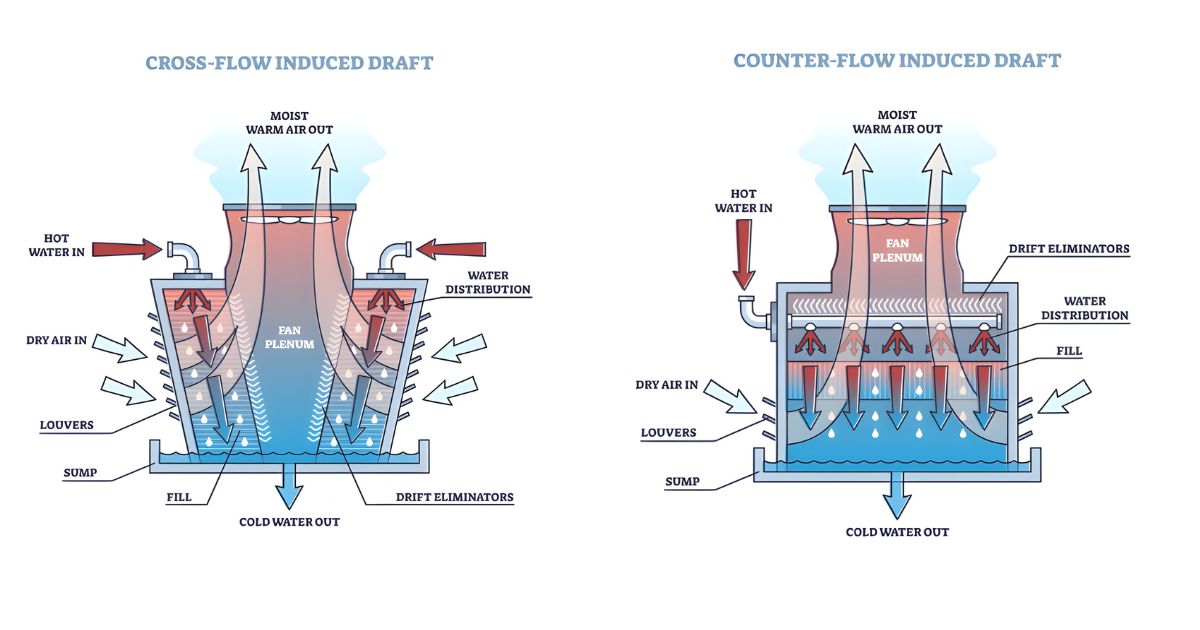
- Air moves horizontally across the downward-flowing water.
- Known for easy maintenance and better performance with dirty water.
- Require more space due to a larger footprint.
Counterflow Cooling Towers
- Air moves vertically upward against the downward water flow.
- More compact, energy-efficient, and precise in cooling.
- Maintenance can be more complex due to tight internal space.
What is a Crossflow Cooling Tower?
A Crossflow Cooling Tower allows air to flow horizontally across falling water. Water is distributed through gravity-fed systems from the top, and the air enters from the sides of the tower.
This simple design is great for industrial setups dealing with dirty or particulate-heavy water, such as fertilizer plants, cement factories, and steel mills.
Benefits of Crossflow Cooling Towers
- Handles Dirty Water Better: Ideal for industries using water with high suspended solids.
- Easy to Maintain: All internal components are easily accessible without shutting down operations.
- Energy Efficient: Lower fan power requirements and less pumping head reduce overall energy costs.
Disadvantages of Crossflow Towers
- Require a larger footprint.
- Can have higher water noise levels due to open inlets.
- Risk of recirculation in certain weather conditions.
What is a Counterflow Cooling Tower?
A Counterflow Cooling Tower operates with air moving vertically upward against falling water. The water is distributed using a pressurized system, ensuring maximum contact between air and water for better heat transfer.
This design provides higher thermal performance and a compact structure, making it suitable for urban or space-limited industrial environments.
Benefits of Counterflow Cooling Towers
- Space-Saving Design: Vertical construction minimizes the footprint.
- Superior Cooling Efficiency: Maximum contact between air and water ensures better performance.
- Low Fouling Options: Compatible with film fill, splash fill, and hybrid fill for different industrial needs.
- Lower Pumping Head: Helps reduce power consumption and long-term operating costs.
Disadvantages of Counterflow Towers
- Higher initial cost due to complex design.
- Difficult maintenance access because of compact internal layout.
- Water noise control can be challenging in some environments.
Cooling Tower Design & Components Overview
Each tower type contains essential components that affect its performance:
- Fill Media: Film fill offers maximum heat transfer; splash fill works best with dirty water.
- Water Distribution System: Crossflow uses gravity-fed systems, while counterflow relies on pressurized spray systems.
- Fan Type: Axial fans provide better efficiency, while centrifugal fans are quieter and suitable for noise-sensitive locations.
Cooling Process Comparison
Both tower types operate on the same principle — evaporative cooling — but the airflow pattern changes how effectively heat is removed.
- Crossflow: Air moves sideways, making maintenance simpler and improving reliability.
- Counterflow Towers: Better energy efficiency but may have a higher carbon footprint if not optimized properly.
Environmental Impact: Crossflow vs Counterflow
Both systems influence energy and water consumption, noise, and evaporation losses.
- Crossflow Towers: Lower energy consumption but higher water evaporation due to open design.
- Counterflow Towers: Better energy efficiency but may have a higher carbon footprint if not optimized properly.
Regular maintenance and efficient fan systems can help minimize environmental impacts in both designs.
Cost Comparison
When analyzing total cost, consider:
- Initial investment
- Operating cost
- Maintenance expense
Crossflow towers usually cost less initially and are cheaper to maintain.
Counterflow towers, though more expensive upfront, offer better energy savings and long-term efficiency.
| Feature | Crossflow Cooling Tower | Counterflow Cooling Tower |
|---|---|---|
| Airflow Direction | Horizontal (sideways) | Vertical (upward) |
| Maintenance | Easy access to internal parts | More complex, tight internal space |
| Space Requirement | Larger footprint | Compact design |
| Thermal Efficiency | Moderate | High |
| Operating Cost | Lower initial & running costs | Higher upfront, lower in long term |
| Best Suited For | Dirty water industries | Space-constrained, high-efficiency operations |
Choosing the Right Cooling Tower for Your Industry
While both designs offer excellent cooling performance, your choice should depend on:
- Available space
- Water quality
- Maintenance preference
- Energy efficiency requirement
Choose Crossflow → if your plant uses dirty water and you want easy maintenance.
Choose Counterflow → if you want compact design and higher cooling efficiency.
At Prakash Cooling Towers, we offer both models with advanced FRP material, ensuring long life, corrosion resistance, and energy savings
Final Thoughts
Both Crossflow and Counterflow Cooling Towers are reliable cooling solutions.For most industrial setups.
- Crossflow = Easy maintenance & dirty water handling
- Counterflow = Higher efficiency & compact design
If you’re looking for long-term performance, low maintenance, and superior cooling, Prakash Cooling Towers has the perfect solution for your industrial needs.